+92 91 9219655
Honourable Director General PSA Mr. Zubair Asghar Qureshi, Respected Vice Chancellor UET Peshawar, Mr. Muhammad Sadiq Khattak, Directors & Deputy Directors of PSA, HODs and Faculty of UET, colleagues, dear participants of 1st Senior Management Course for Technical Departments of KP.
Assalmo Alaikum.
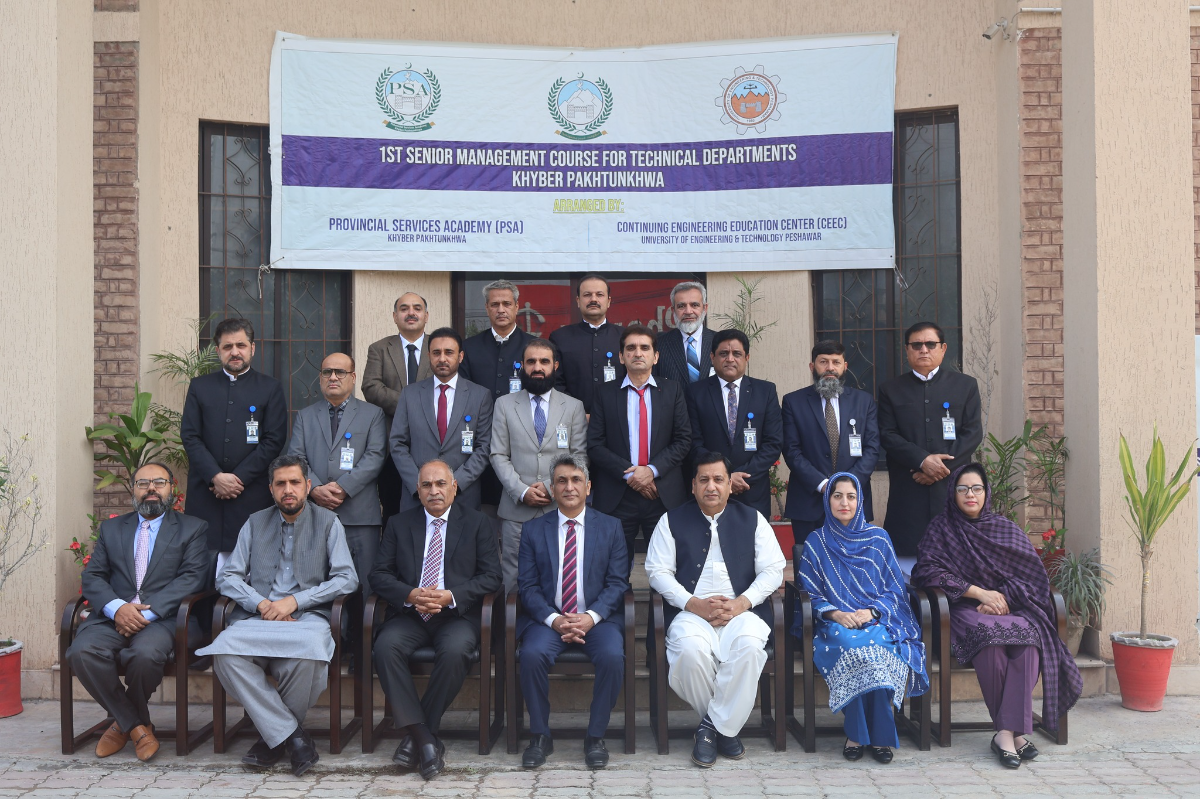
By the grace of Allah, the 1st Senior Management Course for Technical Departments of KP is concluding today. Closing day of this prestigious and pioneering training course is a day of satisfaction, gratitude and fulfilment for the participants, as well as the faculty and entire staff of PSA and our colleagues from UET who were actively involved with the conduct of this training programme. This satisfaction and sense of gratitude gains further significance as it was not long ago that we assembled in this very hall to mark the successful completion of another landmark course for the BS-18 XENs of the C&W department.
Sir, as we all know, Training and capacity building are indispensable instruments of strengthening and improving our public institutions. In an increasingly complex administrative environment, the effectiveness of government depends not only on rules and procedures, but on the ability of officers to think strategically, manage resources prudently, and make informed decisions in the public interest. Well-designed training, therefore, serves as a vital bridge between academic knowledge, field experience, and the evolving demands of public policy and administration.
This 10 to 12-week training course was a significant initiative, being the first Senior Management Course for officers of technical departments. Designing such a course was a challenging yet rewarding task, as the participants were drawn from four distinct departments: Communication and Works (C&W), Irrigation, Science & Technology and Information Technology, and Excise, Taxation and Narcotics Control. Each of these departments has its own operational realities, professional culture, and policy challenges, but there are so many common areas of learning, especially for the senior policy and decision making levels in the public administration hierarchy.
Under the very able leadership of our Director General, we endeavoured to plan this training course with great care and passion so as to ensure that it met the common learning needs of senior officers of all the departments while also addressing their respective departments -specific requirements.
There is a lot for me to report regarding the preparatory phase and practical conduct of the course as there were many challenges, many ifs and buts and a number of firsts, but I will try to limit my narration to a few essential facts.
We got the basic training needs from respective departments and built upon it through further consultations incorporating elements essential for the learning and building of core competencies required for these senior public servants.
The course was thus designed with the clear objective of optimizing participant’s learning and enhancing their readiness for higher responsibilities. Since the officers were being prepared for policy-level positions, the training was structured in two broad phases. The first phase of General Management & Public Administration focused on strengthening their understanding of the public policy environment, sharpening their leadership skills and decision-making capacities. The phase started with foundational module of IT, E-governance and AI. The module comprised basic ICT orientation and IT skills, Innovative Trends in IT, Cyber Security, Data Analytics & Artificial Intelligence, IT application in office management and provincial government working, E-Governance & Change Management in Digital Transformation in C&W, ET&NT, Irrigation, ST&IT departments, Integrating GIS in planning & decision making process of C&W, Irrigation & ET&NC. Class room learning of the IT, E governance and AI Module was supplemented by visit to P&Ds GIS hub and provincial governments data centre.
The ICT Module was followed by other essential foundational module on Management Techniques and Skills comprising Basic Management concepts, Research Methodology, Negotiation and Conflict Resolution, Stress Management, Team Building, Time & Workload Management, Performance Management in Public Sector, Developing KPIs, Public Speaking and Communication skills.
As the course progressed and the participants knowledge base and general public policy awareness was gradually strengthened relatively, we delivered slightly heavier content of Public Administration, Office Procedures, Laws, Rules and Procedures and financial management through various training techniques such as Interactive lectures, Syndicate work, Case study, assignments presentations etc.
Some topics covered during this phase included; General Financial Management, Budget making, Handling Audit observations, Roles and Responsibilities of DDOs and Delegating Financial powers, Procurement process, Contract Management, Rules of business, Civil Servants Act, E&D & Conduct Rules, APT Rules, Project Cycle management, Project Monitoring & Control, Project Conceptualization and Alignment with Departmental Goals, Land Use planning, Interaction with judiciary, handling court cases, Accountability in public service
Disaster Risk Reduction and Climate Resilient Development Modules were also made an integral part of the course.
The aim was to equip the officers with a broader institutional perspective and to refine the knowledge base and competencies required for senior leadership in the provincial government.
The second phase of the course focused on domain-specific content tailored to the needs of four departments represented in the cohort. This helped the participants relate general management principles to their own professional areas and encouraged cross-learning across disciplines. Officers from C&W, Irrigation, Science & Technology and IT, and Excise, Taxation and Narcotics Control benefited from exposure to both shared administrative concepts and specialized subject matter relevant to their work. The Domain specific modules covered essential areas for Road Asset Management, Building Design for C&W, Contract management & dispute resolution, Land use & Building Control Act, Solarization for energy conservation, Land Acquisition Process for Public Sector, Public Private partnership for C& W officers, Taxation system at Federal, Provincial and local levels, Property Tax Challenges & Prospects, Digital Solutions in taxation, Motor Vehicle registration issues, Narcotics Control for ET&NC officers.
Flood Risk assessment (Hydrological studies), Irrigation systems in KP, Water Distribution issues, Water Resource Management for Irrigation Engineers. Information systems, data analytics, e-gvernance and IT solutions pertaining to the work domain of ST&IT officers formed the underlying themes throughout the course
I can safely say that we covered almost all the relevant aspects of these officers learning process at this stage of their careers. Their course was thus a nice blend of technical topics and management skills. This balanced design ensured that the course remained both broad in vision and practical in application.
All these modules were delivered through a mix of training methodology such as Lecture discussions, Case Studies, tutorial Discussions, Workshops, Local Field visits, Inland study tour, Exercises, Current Issues presentations, Research policy papers, etc
Utmost effort was made to engage quality resource persons. Professionals, Technocrats, Practitioners, scholars and Persons from Public sector, Nongovernmental as well as corporate sector were identified and engaged as Resource persons. Many experts were invited over from Islamabad, NHA, Planning Commission, Private Consultants, etc.
Inland Study Tour of the course was again carefully designed to cater to the learning requirement of a diverse cohort that could help in their overall capacity building as well. The tour was conducted to Islamabad Lahore & Gujranwala. Organizations and departments for visit were very identified in consultation with the participants’ themselves in terms of relevance to their learning needs. Hence they were afforded the opportunity to visit NHA, Planning Commission, Public Procurement Authority in Islamabad; in Lahore they visited ACS development, where secretaries of all the relevant departments were present. Also visited C&W, and Punjab Irrigation department, Suthra Punjab Project, Excise & Taxation and Narcotics Control Departments, as well as Punjab Revenue Authority, Punjab IT Board in Arfa Karim IT PARK where they were given briefing on many initiatives of the Punjab Government including E biz, Hydraulic Research Centre in Nandipur Gujranwala as well as the very impressive flag lowering ceremony at Wahgah border. Five participants of Excise & Taxation were also attached with Federal Anti Narcotics Force , FBR PRAL and Excise & Taxation Islamabad for a few days during the 2nd last week of the course.
Similarly Local field visits to :
· P&D, GIS Hub, PCFMS, Data Centre
· BRT Head office in Chamkani
· KPRA
· WSSP
Case Study on Organizational Behaviour and HR Management in public sector was conducted to strengthen their understanding of the important issues in Human resource management and public organizational culture.
Sir the participants were provided ample opportunities of presentations to polish their communication skills. Hence, thought of the day, case studies, departmental presentations, Local field visits, IST, Group policy paper etc, and at every available opportunity they were given the chance to come on to the stage for making presentations.
Public service ethics, and character building are essential components of any meaningful training programme. We focused these areas through training discipline, adherence to timelines, and work ethics as well as special session on public service ethics in the light of Quran and Sunnah. A very special initiative to this end was the Tadabur ul Quran series that enabled each participant to select ayaat from the Quran and present their explanation and tafseer through Research from various sources and relate it to professional conduct and ethics.
Let me acknowledge the fact that effective conduct of this course was only possible due to tremendous team work and exemplary commitment and hard work of the entire team of PSA and UET. Hence, I take this opportunity to thank our colleagues and team members from Engineering University. Dr. Fayaz Khan, and his colleagues remained fully involved throughout the training. Officers and staff of CEEC and UET and the UET staff hostel were all an important part of our team.
My PSA faculty colleagues and Admin staff were fully and meaningfully involved in arranging and conducting this pioneering training programme. The understanding and support shown by my fellow CI, Khan Muhammad sb throughout the course was unprecedented and unwavering. Mr. Waqas Saliheen shouldered extra responsibilities as D.S Trg & Coord. Ms Rukhsana Jabeen proved to be the key team member with her remarkable commitment and positive attitude during her full time presence in the classroom. Similarly our colleagues from Admin and Accounts, Director Syed Kazim Hussain, Dy. Directors Ms. Misbah, Mr. Qasim, Shah Rukh and other staff at PSA always provided full and swift support to the training cause, while essentially remaining behind the scene. I must also acknowledge the commitment and untiring efforts of our training section comprising especially Mr. Sajid Nabi who could always be trusted with any work anytime and anywhere, Iqtidar, and Imadad.
This smooth functioning of all the team members from PSA and UET surely owes the inspiration and full commitment of the leadership of the two organizations. I extend heartfelt gratitude to the Vice Chancellor UET for his ownership of the training cause and for his dynamic and inspiring leadership.
As Chief Instructor of this training course, I am truly grateful to our Director General, for his trust, guidance and support at each and every step of the training programme. It was his total trust, kind guidance and dynamic leadership that enabled us to work as one united and functional team without any area of concern.
I think, I won’t be doing justice to the participants, if I fail to mention their discipline and attitude towards the training. They remained fully committed to the learning process and showed good insight and understanding of most professional matters. I congratulate the passing out participants and wish them the best of luck in their endeavour to serve the public. Thankyou ladies and gentlemen